What is performance marketing design? (and why it matters)
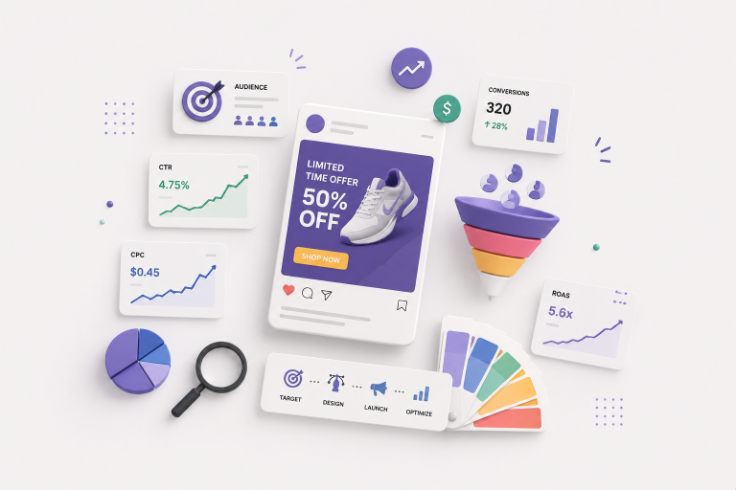
TABLE OF CONTENTS


TL;DR
Performance marketing design is the practice of creating ads, landing pages, and campaign assets to hit a measurable goal (clicks, sign-ups, sales) and then improving them based on real data. It is different from brand design, which builds recognition over time. It matters because creative quality drives roughly half of an ad campaign's sales lift, more than targeting or media spend. The catch: it only works if you can produce enough variations to test, which is where most teams get stuck.
Introduction
Your ad budget is climbing. Your cost per click keeps creeping up. And still design still feels like an afterthought, even though it’s the one component that moves results the most. That is the gap performance marketing design fills.
Most marketers optimize audiences, bids, and placements for weeks while running the same two ads. Then they wonder why performance flattens. The truth is less about the algorithm and more about what you put in front of people. This guide breaks down what performance marketing design actually is, why it moves the needle, what it looks like across channels, and how to produce it without burning out your one designer.
What is performance marketing design?
Performance marketing design is the creation and continuous optimization of visual assets built to drive a specific, trackable action. Think paid social ads, display banners, landing pages, and email graphics. Every design decision, from the headline to the button color, is treated as a testable hypothesis and judged by a metric like click-through rate or cost per acquisition.
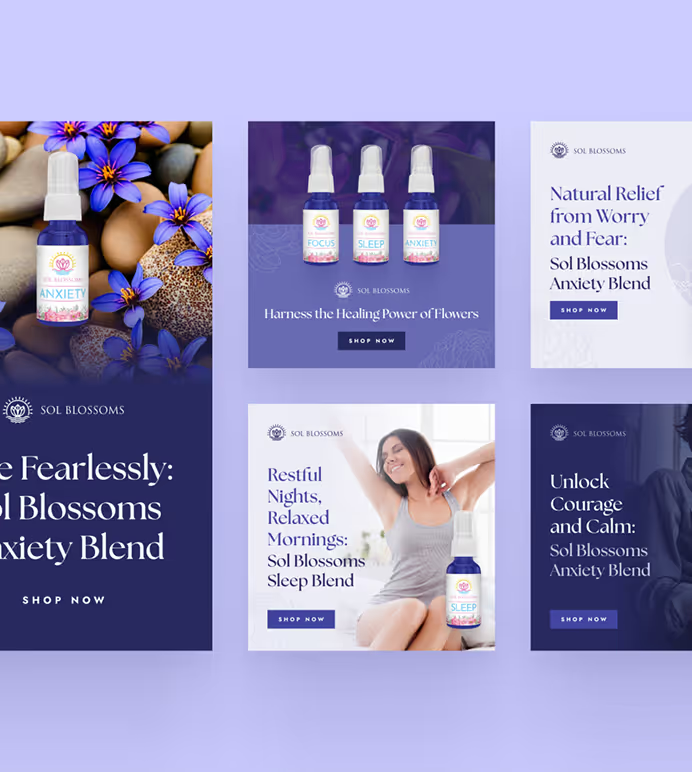
In practice, it flips the traditional design process. Instead of a designer creating one "final" ad and calling it done, they produce several versions of the same concept: a pain-led hook against a benefit-led one, a product shot against a lifestyle image, a short headline against a specific claim. You run them, watch the data, and scale the winner.
You will also see this called performance creative or creative performance marketing. The terms are close to interchangeable. All of them describe the same shift: design decisions backed by numbers, not just taste.
Performance marketing design vs. brand design: what's the difference?
Brand design shapes how people feel about your company over time and is measured in awareness, recall, and sentiment. Performance marketing design drives a specific action inside a measurable channel and is judged in days by clicks, conversions, and cost per result. Most marketing programs need both.
The mistake is treating them as rivals. Strong brand design makes performance design work harder, because a recognizable, trusted brand converts more efficiently. The real difference is what you optimize for and how fast you get feedback.
The practical takeaway: with brand design you protect consistency, and with performance design you treat each asset as a test. One is a foundation, the other is an experiment.
{{BRAND_BANNER="/dev/components"}}
Why does performance marketing design matter?
It matters because creative is the single biggest driver of advertising results. Nielsen's analysis of ad effectiveness found that creative accounts for roughly 49% of a campaign's sales lift, more than media, targeting, or reach combined. If you are pouring hours into audience settings and leaving your creative static, you are optimizing the smaller lever.
Here's the thing: ad costs keep rising, and audiences saturate faster than they used to. When your cost per thousand impressions climbs, better creative is one of the few levers that lowers your cost per result without spending more. It is cheaper to test a new hook than to buy your way out of fatigue.
And creative fatigue is real. The same ad shown too many times stops working, engagement drops, and costs rise. Performance marketing design is the system that keeps a fresh, tested asset ready before the current one burns out. Without it, you are always reacting late.
What does performance marketing design look like across channels?
Each channel has a different job, so each design test is built around how that channel works. What wins on paid social will not automatically win in an email. Here is what performance marketing design looks like where it actually runs.
Paid social ads
Paid social is the most common home for performance creative because results come back fast. Running several versions side by side shows you which angle wins before you scale spend. Common tests include pain-led vs. benefit-led hooks, static vs. video, polished brand-led creative vs. raw UGC-style content, and CTA variations like "Shop Now" against "Get Started." If you run Meta ads, our guide to a winning Facebook ad design goes deeper on what to test.
Display and banner ads
Display design usually comes down to one question: can someone understand the offer in a second or two? Tests here focus on clarity, static vs. animated creative, offer visibility, CTA button treatment, color contrast, and how the layout holds up across different ad sizes. Our breakdown of display ad design that drives clicks covers the mechanics.
Landing pages
Landing pages are where the click turns into a decision. A strong ad earns the visit, but the page has to carry the message forward. Tests include hero headline variations, CTA placement and copy, the order you present benefits, social proof placement, and short-form vs. long-form structure. A mismatch between the ad and the page is one of the fastest ways to waste spend.
Email campaigns
Email performance design starts before the reader even opens the message. Subject lines, preview text, and sender name decide whether it gets attention at all. Inside, you test hero banner design, offer framing, product image selection, and CTA copy. Small changes to the header graphic or the framing of an offer can move open and click rates more than you would expect.
Which metrics tell you it's working?
The right metric depends on what the creative is meant to do. A high click-through rate means nothing if nobody converts, so read the numbers together rather than in isolation. These are the signals worth watching.
Watch for the trap of optimizing a vanity metric. A clickbait ad can win on CTR and lose on conversion quality, pulling in traffic that never buys. Judge creative on the metric closest to revenue for that campaign.
How do you actually produce performance marketing design?
This is where most teams hit a wall. Performance marketing design only works if you can produce enough variations to test, refresh winners before they fatigue, and do it across every channel at once. The strategy is simple. The production is the hard part.
Be real: testing five hooks across three formats for two channels is easily 30 assets, and that is one campaign in one week. A single in-house designer cannot keep that pace and also handle the rest of their queue. So teams get stuck running the same tired ads, not because they lack ideas, but because they lack the hands to build them.
You have a few options for closing that gap, each with a trade-off:
- In-house designer: Best for brand consistency and speed of communication, but one person becomes a bottleneck the moment testing volume ramps up.
- Freelancers: Flexible and good for overflow, but quality varies, and re-briefing a new person on your brand every time eats the time you saved.
- Creative agency: Strong on strategy, but the retainers are steep and turnaround is often too slow for a weekly test cadence.
- Design subscription: A flat monthly fee for a dedicated design team that turns around requests day after day, built for exactly this kind of steady, high-volume output.
That last model, sometimes called creative as a service, exists because performance marketing created a production problem that the old models could not solve affordably. At ManyPixels, we deliver a daily output every business day, so instead of waiting a week for one polished ad, marketing teams get a steady stream of tested variations across paid social, display, email, and landing pages.
{{GENERAL_PORTFOLIO="/dev/components"}}
What are the most common performance marketing design mistakes?
The strategy breaks down in predictable ways. Most failures come from moving fast without a clear testing structure, not from bad design. Here are the ones worth avoiding.
- Testing too many variables at once. Change the headline and the image and the CTA together, and you will never know which one moved the result. Isolate one variable per test.
- Ignoring conversion quality. A high CTR that brings unqualified traffic is a cost, not a win. Optimize for the action that ties to revenue.
- Going off-brand to chase clicks. Creative that looks nothing like your brand can spike short-term but erodes the trust that makes every future ad convert better.
- Letting winners fatigue. Even a great ad decays with overexposure. Refresh it with new formats and hooks before performance drops.
- Producing too slowly. If it takes two weeks to build the next test, the insight is stale by the time you act on it. Speed of production is part of the strategy, not separate from it.
The pattern behind all five: performance marketing design is a system, not a one-off asset. Treat it like a habit, and the results compound.
Frequently asked questions
The bottom line
Performance marketing design is the discipline of building creative to hit a number and improving it with data, and it is the highest-leverage part of most ad programs because creative drives close to half of campaign results. The teams that win are not the ones with the cleverest targeting. They are the ones who can produce and test enough creative to keep finding what works. If production is your bottleneck, a design subscription is the model built to solve it.
Got a backlog of ad tests you cannot get built? That is exactly the problem we handle every day.

Having lived and studied in London and Berlin, I'm back in native Serbia, working remotely and writing short stories and plays in my free time. With previous experience in the nonprofit sector, I'm currently writing about the universal language of good graphic design. I make mix CDs and my playlists are almost exclusively 1960s.

Top-quality designers
A complete creative team at your fingertips: graphic and web designers, illustrators, and more.

Lightning-fast turnaround
Get start today and receive your first update on the next business day.

All-inclusive pricing
Unlimited requests and revisions. One flat monthly fee. No surprises.

Flexible & scalable model
No contract. Scale up and down as needed. Pause or cancel at anytime.
Continue reading


Explore some of our best designs
Get inspired by a curated selection of ManyPixels work. Download the portfolio to see what our team can create.